Humans and AI : Partners in Thought, Action, and Responsibility.
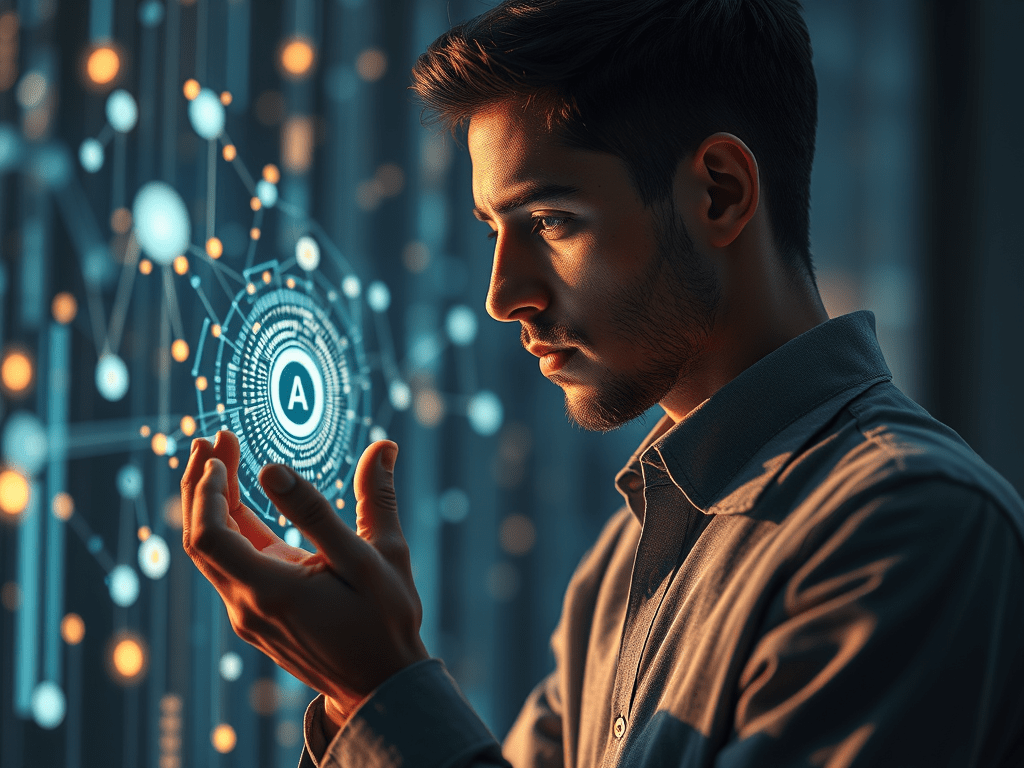
In the last decade, artificial intelligence (AI) has moved from the realm of speculative science fiction to a practical companion in everyday work, creativity, and decision‑making. Yet the closer AI integrates into our lives, the clearer one truth becomes: AI is not a replacement for human beings – rather, it is a mirror, magnifier, and multiplier of human intent.
If we want to use AI wisely, we must ask not only what can the machine do? but also what do we, as humans, choose to do with it? The relationship between humans and AI unfolds across four deeply human domains – meaning, ethics, creativity, and connection – each rooted in questions only people can fully answer.
1. Meaning – AI gives data; humans give meaning
(Who frames the problem?)
AI excels at producing outputs: numbers, probabilities, summaries, patterns, correlations. Feed it the right dataset, and it can tell you what trends are rising, what prediction has the highest probability, or what decision is mathematically optimal under given conditions.
But numbers are not narratives. A data point has no voice until someone interprets it. A statistic has no moral weight until someone asks, Does this matter? AI can calculate patterns in climate data, but it’s a human scientist or policymaker who frames the problem as, How do we protect vulnerable communities from rising sea levels? Without that framing, AI merely returns the ocean temperature in Celsius; only humans add the layer that says, this means danger for millions of people.
Framing the problem is not a small step; it is the defining step. Every AI result is shaped by the problem asked of it, and that problem in turn is shaped by human perspective, bias, ambition, and values. A poorly framed question can turn the most advanced algorithm into a tool for the wrong task. For instance:
• If asked, “How can we maximize clicks for this online platform?”, AI may produce engaging but addictive or misleading content, because the objective was clicks, not truth.
• If reframed as, “How can we maximize high‑quality engagement that benefits the user’s long‑term interests?”, AI’s optimization would take a very different form.
In this sense, humans are the authors of purpose. AI needs human clarification not just at the start but continuously. We refine, constrain, and reframe the work as new insights emerge. Data without human questioning is inert; human questioning without data might be uninformed. Together, they create meaning.
2. Ethics — AI optimizes; humans ask, “Should we?”
(Who owns the consequences?)
AI’s great gift and risk is its ability to optimize. It can find the most efficient route, the quickest result, the most statistically probable answer. But optimization is not morality; speed is not wisdom. An AI can optimize medical resource allocation in a hospital, but if the criteria are biased or incomplete, it may inadvertently prioritize patients based on socioeconomic status or demographic trends rather than medical need.
That’s where humans must step in not as passive receivers of AI’s answers, but as guardians of consequences. We must hold the moral lens that AI does not possess. The machine can weigh factors but has no inherent concept of fairness, dignity, or harm. Those are human constructs, shaped by culture, law, philosophy, and lived experience.
This raises a fundamental accountability question: When something goes wrong, who is responsible the AI, the developer, the user, or society at large? The uncomfortable truth is that responsibility rests with people. We designed, deployed, and relied on the system; we cannot outsource guilt or praise to code.
This is why AI ethics is not simply about technical safeguards it’s about governance and clear ownership of decisions. We must embed ethical questioning at every stage of AI’s lifecycle:
• Design phase – Which datasets should be used? Are they representative?
• Deployment phase – Who monitors performance? How do we detect harmful bias?
• Impact phase – If harm is caused, how do we remediate and prevent recurrence?
Ethics also forces us to confront scenarios where not using AI might be the more moral choice. Just because an algorithm can predict an individual’s likelihood of committing a crime does not mean society should deploy it. In such moments, the human role is to step back and weigh the “should” against the “can.”
AI’s compass is mathematical; human conscience gives it direction.
3. Creativity – AI iterates; humans imagine
(Who dares to redefine the question?)
Creativity is often described as the intersection of novelty and usefulness. AI can already generate creative‑looking outputs—paintings in the style of Van Gogh, symphonies in the mood of Beethoven, or marketing slogans that sound catchy. Yet much of this is derived creativity: AI blends vast past data to generate something that feels original but is usually an echo of what already exists.
Humans, in contrast, can make the unexpected leap—the kind that reshapes not only the answer but also the question itself.
For example, if tasked with designing a lighter car, AI may iteratively propose ways to use stronger yet lighter materials, or optimize the vehicle shape for aerodynamics. A human might stop mid‑process and ask: Do we need cars at all for this application? Could we rethink urban transport entirely? That reframing is where radical innovation begins.
AI’s iterative power is real, it can run through hundreds of design possibilities in minutes, enabling human creators to explore more directions than ever before. This makes AI a powerful creative amplifier:
• A novelist can use AI to brainstorm character backstories.
• A product designer can prototype dozens of variations before selecting the most promising.
• A scientist can simulate thousands of molecular structures to accelerate drug discovery.
But the original spark the ability to sense a possibility no dataset has yet recorded—remains a human gift. The courage to redefine the question, to pursue an idea that does not yet have supporting data, often comes from intuition, lived experience, or an almost irrational faith in a vision.
If AI is the engine for exploring permutations, humans are the pilots who decide which path is worth the journey.
4. Connection – AI communicates; humans build trust
(Who inspires the team when morale dips?)
We live in a networked age, where communication is constant. AI can now send personalized emails, translate between dozens of languages, and even mimic a human voice with near‑perfect accuracy. These capabilities make communication faster, broader, and sometimes more accessible.
But communication is not the same as connection.
Connection is an emotional bridge—it grows not from the mechanics of sending a message, but from the mutual trust built between sender and receiver. A leader delivering a speech to a team after a tough quarter is not merely communicating results; they are reading the room, acknowledging unspoken fears, and inspiring renewed commitment. AI can simulate empathy in text, but it does not feel the shared history of a team, nor the personal stakes of a mission.
Even interpersonal trust is built over time through shared experiences, consistent actions, and the vulnerability of being human. AI can help teams coordinate and share information more effectively, but it cannot replace the moment when a mentor takes a junior employee aside and says, “I believe in you, even after that mistake.” Such gestures are not calculated—they are lived.
Furthermore, trust plays a critical role in how AI itself is adopted. Users need to trust the AI’s output, but more importantly, they need to trust the human systems overseeing AI’s use. This requires openness, clear explanations, and honesty about limitations—all deeply human commitments.
In workplaces of the near future, the most successful leaders will be those who know how to blend AI’s reach with human presence: using AI for precision and scalability, while showing up in person (or in a human voice) when what’s at stake is not just accuracy, but belief and morale.
The Human–AI Symbiosis
When we look across these four dimensions—meaning, ethics, creativity, and connection—a pattern emerges: AI extends human capacity, but humans define the compass, context, and conscience.
• Without human meaning, AI’s data is directionless.
• Without human ethics, AI’s optimization can harm.
• Without human imagination, AI’s iteration is bounded by what already exists.
• Without human connection, AI’s communication risks feeling hollow.
The future is not a competition between humans and AI, but a collaboration in which each plays to its strengths. AI augments human decision‑making, and in turn, humans give AI’s capabilities a purpose worthy of pursuit.
Challenges in the Partnership
However, embracing this partnership is not without difficulty. Several tensions must be acknowledged and navigated:
1. Over‑reliance – The ease and speed of AI outputs can tempt us to accept them uncritically, dulling our problem‑framing skills. Continual critical thinking remains essential.
2. Bias Amplification – AI models learn from human data, inheriting and even amplifying historical prejudices if not carefully managed.
3. Erosion of Skills – In areas like writing, analysis, or translation, heavy AI use may make human practitioners less skilled over time if not balanced with deliberate practice.
4. Trust in the Wrong Places – It’s possible to build trust in an AI system that’s not fully reliable, leading to significant harm if transparency and validation are ignored.
These are not arguments against AI; rather, they are reminders that a powerful tool’s value is locked to the wisdom of its use.
A Shared Journey Forward
The deeper philosophical point is that AI is not truly “other.” It is an extension of human problem‑solving, encoded in algorithms. Every dataset it processes was shaped by human behavior, choices, omissions, and culture. To talk about AI’s flaws is also to describe humanity’s own.
Therefore, the Human‑AI story is one of co‑evolution:
• As AI advances, humans must strengthen framing skills, so that we pose better, more meaningful questions.
• As AI grows capable of optimization at scale, humans must deepen their ethical frameworks to prevent harm and advance shared good.
• As AI broadens creative possibilities, humans must become braver in imagination, unafraid to redefine the question entirely.
• And as AI makes communication ever more instantaneous, humans must recommit to trust, empathy, and genuine connection.
We may one day see AI agents that can simulate ethical reasoning, broaden creative leaps, or approximate emotional support, but the point will not be whether AI “replaces” humanity in those tasks. The point will be whether we still choose to show up as humans, bringing our full capacity for judgment, care, and wonder.
Final Reflection
The age of AI is not the end of human uniqueness—it is the beginning of a test. A test of whether we can use unprecedented tools without losing the very qualities they cannot replicate. The four truths we must carry are simple yet profound:
1. Meaning: AI can give us data, but we must give it purpose.
2. Ethics: AI can optimize, but we must ask if it should.
3. Creativity: AI can iterate, but we must dare to imagine.
4. Connection: AI can communicate, but we must build trust.
In the end, AI will be remembered not for the answers it gave us, but for the questions, we had the courage to ask. And those questions will always come from a place no machine can reach the human heart.
Its we the Humans to choose how we use the Tool, as the craftsman is always skillful than the most sharper tools.
 Envisage
Leave a comment